

Medical Simulation Industry Growth to Hit US$5.6Bn by 2032 – Persistence Market Resaerch
medical simulation market
The medical simulation market is expanding rapidly, driven by advancements in technology, patient safety, and training solutions for healthcare professionals.
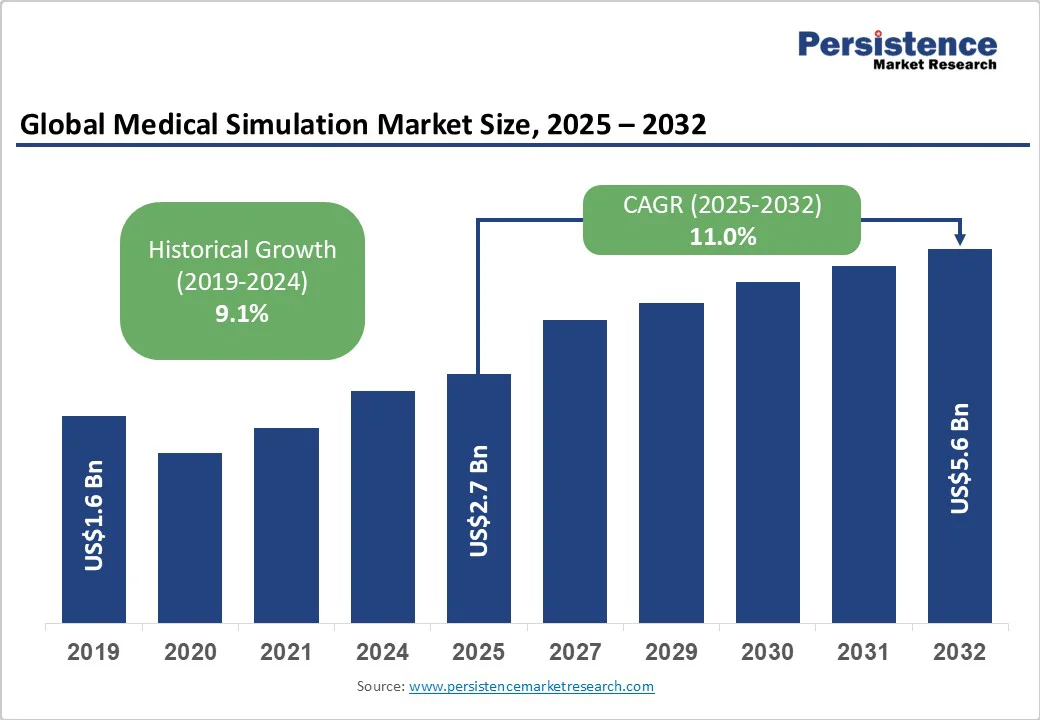
LONDON, UNITED KINGDOM, February 17, 2026 /EINPresswire.com/ -- The global medical simulation market is poised for substantial growth, projected to reach US$5.6 billion by 2032 from an estimated US$2.7 billion in 2025, expanding at a compound annual growth rate (CAGR) of 11.0% during the forecast period of 2025-2032. This growth is primarily fueled by the ability to practice medical procedures on simulators instead of real patients, significantly reducing the risk of errors and enhancing patient safety.
Download Your Free Sample & Explore Key Insights: https://www.persistencemarketresearch.com/samples/32070
Key Industry Highlights
Leading Product Type: Anatomical models are expected to capture nearly 36.5% of the market share in 2025, owing to their ability to offer realistic, hands-on learning experiences that help trainees understand human anatomy in detail. These models simulate organs, blood vessels, and pathologies, enabling learners to practice without the risk of harming actual patients.
Dominant Technology: Procedure rehearsal technology will dominate the market, accounting for approximately 42.6% of the market share in 2025. This technology allows healthcare professionals to rehearse complex surgeries using patient-specific data, helping them refine techniques before performing procedures on real patients.
Key End-User: Academic institutions will continue to be significant end-users of medical simulation technologies, holding an estimated 32.9% market share in 2025. They use simulations to train the next generation of healthcare professionals in clinical decision-making, surgical procedures, and emergency interventions.
Market Drivers: Patient Safety and Skill Enhancement
The primary driver of growth in the medical simulation market is the ability to practice procedures on simulators, which reduces the risk of errors in clinical settings and enhances patient safety. For instance, immersive surgical simulators like those offered by Osso VR allow surgeons to rehearse orthopedic and spinal surgeries, identifying potential complications before performing them on real patients. This hands-on experience builds confidence and competence among medical trainees.
In addition, medical simulation enables better team performance. Hospitals and medical centers are increasingly using simulations to train interdisciplinary teams—comprising doctors, nurses, and allied health professionals—to improve coordination, communication, and crisis management skills. Simulated scenarios, such as trauma response or cardiac emergencies, allow healthcare teams to develop situational awareness and rehearse communication strategies, which ultimately reduces medical errors and improves patient outcomes.
Get Custom Insights Designed for Your Business: https://www.persistencemarketresearch.com/request-customization/32070
Barriers: Realism and Simulation Bias
Despite the many advantages, there are challenges associated with medical simulation. One of the major barriers is the limited realism of simulated environments. While high-fidelity mannequins and virtual reality systems offer a lifelike experience, they cannot fully replicate the complexity of real clinical situations, such as subtle physiological variations or unexpected patient reactions. For example, surgical simulators may not fully mimic unforeseen complications like sudden patient deterioration, which could leave a gap in the learner's experience when transitioning to real-life clinical practice.
Another challenge is simulation bias, which occurs when learners behave differently in simulated environments compared to real-world situations. In a controlled environment, trainees may take more risks or approach procedures with less caution, leading to inflated confidence levels that don't always translate to effective decision-making in high-pressure, real-life scenarios. This bias can be particularly problematic in high-stakes medical fields, where judgment and decision-making skills are critical.
Opportunities: Haptic Feedback and Technology Integration
One of the most promising opportunities for the medical simulation market is the integration of haptic feedback technology. This technology enables trainees to feel realistic tactile sensations during procedures, such as the texture, resistance, and responsiveness of tissues and organs. By providing a sensory experience that closely mimics actual surgery, haptic feedback enhances skill development and helps reduce the learning curve for complex procedures. Companies like Touch Surgery and VirtaMed have already incorporated haptic-enabled simulators for laparoscopic and orthopedic procedures, improving real-time manual skills and boosting confidence in performing delicate surgeries.
Regional Trends: North America, Europe, and Asia-Pacific
North America, particularly the United States, is leading the medical simulation market, driven by significant investments in healthcare education and the adoption of advanced simulation technologies. Academic institutions and hospitals are using these tools extensively to improve the competency of healthcare professionals. For instance, Methodist Healthcare in San Antonio has invested in upgrading its nurse simulation facility with high-fidelity mannequins to offer realistic training scenarios.
In Europe, countries such as Italy, France, and Spain are making strides in medical simulation. Institutions like the Besta NeuroSim Center in Milan and the Center Lyonnais d'Enseignement par la Simulation en Santé in France are pioneering neurosurgical and immersive learning strategies. The European market is supported by collaborative efforts among hospitals, universities, and simulation experts.
In the Asia-Pacific region, countries like China and Japan are rapidly embracing medical simulation, driven by government support and growing demand for high-quality healthcare education. Companies like MedVisionSim are making affordable, portable simulation tools widely available in the region, further contributing to the growth of the market.
Checkout Now & Download Complete Market Report: https://www.persistencemarketresearch.com/checkout/32070
Competitive Landscape
The medical simulation market is characterized by technological advancements and rising demand for effective training solutions. Leading players in the industry include CAE Healthcare, Laerdal Medical, Gaumard Scientific, Kyoto Kagaku, and MedVisionSim. These companies offer a wide range of simulation solutions, from high-fidelity mannequins to VR-based training platforms. Cost leadership remains a significant strategy, with firms like MedVisionSim focusing on providing high-quality, portable solutions at competitive prices.
Market Segmentation
By Products and Services
Anatomical Models
Web-based Simulation
Medical Simulation Software
Simulation Training Services
By Technology
Virtual Patient Simulation
3D Printing
Procedure Rehearsal Technology
By End-user
Academic Institutions
Hospitals
Military Organizations
Research
By Region
North America
Europe
East Asia
South Asia & Oceania
Latin America
Middle East & Africa
Read Related Reports:
Elder Care Services Market: The global elder care market, valued at US$1.6 Bn in 2025, is set to reach US$2.6 Bn by 2032, driven by aging populations and rising chronic conditions.
Molecular Transport Medium Market: Molecular transport medium market to reach US$1,263.2 Mn by 2032, fueled by growing need for contamination-free sample collection in diagnostics and research.
Persistence Market Research
Persistence Market Research Pvt Ltd
+1 646-878-6329
email us here
Visit us on social media:
LinkedIn
Instagram
Facebook
YouTube
X
Legal Disclaimer:
EIN Presswire provides this news content "as is" without warranty of any kind. We do not accept any responsibility or liability for the accuracy, content, images, videos, licenses, completeness, legality, or reliability of the information contained in this article. If you have any complaints or copyright issues related to this article, kindly contact the author above.
